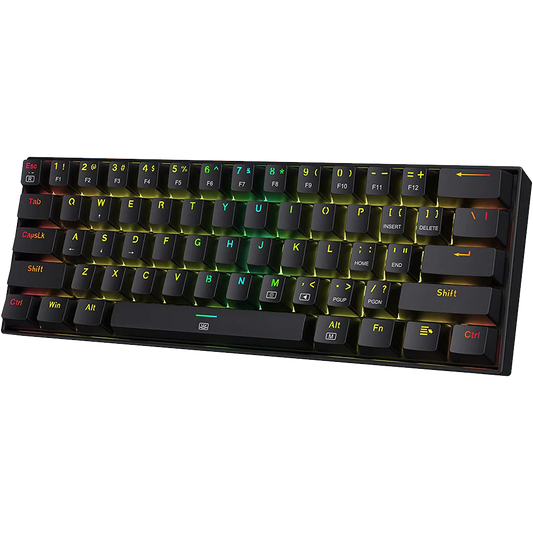

The ATK V75X and Aula F75 are both triple-mode wireless 75% keyboards with gasket mounts, hot-swap PCBs, 4000mAh batteries, 1000Hz polling rates, double-shot PBT keycaps, per-key RGB lighting, and support for 3-pin and 5-pin MX-compatible switches. On paper they cover the same ground. In practice, they differ in case material, internal dampening stack, switch variety, quick-trigger availability, and the design priorities each keyboard reflects.
The Aula F75 starts at ₹5,999. The ATK V75X starts at ₹6,799. Both are available through Vrkaa and ship across India. This comparison covers the differences that matter in daily use.

Full Specification Comparison
| Specification | ATK V75X | Aula F75 |
|---|---|---|
| Layout | 75% (80 keys) | 75% layout |
| Case Material | CNC Aluminum Top Case | ABS Plastic |
| Weight | 1.023 kg | 1.023 kg |
| Mount | Game-Gasket Structure | Gasket-Mounted Construction |
| Battery | 4000mAh | 4000mAh |
| Connectivity | USB-C / 2.4GHz / Bluetooth | USB-C / 2.4GHz / Bluetooth |
| Polling Rate | 1000Hz (SMART SPEED X chip) | 1000Hz (wired and 2.4GHz) |
| Quick-Trigger | Yes (Arctic Fox + V HUB) | No |
| Keycaps | Double-shot PBT, Cherry Profile | Double-shot PBT |
| Backlighting | Per-key ARGB (independent IC) | Full RGB |
| Hot-Swap | 3-pin and 5-pin MX-compatible | 3-pin and 5-pin MX-compatible |
| Switch Options | 5 options (4 linear + 1 tactile) | 4 options (all linear) |
| Tactile Switch Option | Yes (Arctic Fox) | No |
| Internal Dampening Layers | 5 layers | 7 layers |
| Stabilizers | ATK V1 Stabilizers | Standard stabilizers |
| Media Knob | No | Yes (multi-function media and lighting knob) |
| Software | V HUB | Aula software (Windows) |
| Price Range (India) | ₹6,799 to ₹8,299 | ₹5,999 to ₹7,999 |
Case Material: Aluminum vs ABS Plastic
The ATK V75X uses a CNC aluminum top case. The Aula F75 uses an ABS plastic case. Both are used widely in mechanical keyboard construction and each has trade-offs.
CNC aluminum is machined from solid metal. It does not flex, adds weight compared to plastic, and produces a crisper resonance character. The ATK V75X pairs its aluminum case with five internal dampening layers to keep the sound profile controlled. The keyboard stays planted on a desk due to its weight, which suits fixed desk setups.
The Aula F75's ABS plastic case is standard for the category and performs well alongside its gasket mount structure. At 1.023 kg, the Aula F75 is not a lightweight keyboard either. ABS plastic is easier to manufacture in more colorways and at lower cost, which partly explains the Aula F75's wider color range and starting price.
Keycaps: Both PBT, Different Profiles
Both the ATK V75X and Aula F75 ship with double-shot PBT keycaps. Double-shot PBT legends are moulded during manufacturing and do not fade, shine, or wear with daily use. This is an advantage both keyboards share over alternatives that ship with ABS keycaps.
The ATK V75X uses Cherry profile, which is a shorter, stepped cylindrical profile. Cherry profile suits touch typists and produces a slightly different sound character due to the reduced keycap height. The Aula F75's exact keycap profile varies by colorway; check the individual product listing on vrkaa.com for profile details on your specific variant. Aftermarket keycap sets fit both keyboards as both use standard MX-compatible stems.
Sound and Internal Dampening
The Aula F75 includes seven internal dampening layers: a slotted PC positioning board, PO sound-absorbing cotton, IXPE shaft bottom pad, PET voice actor pad, single-key slotted PCBA board, PO base cotton, and a silicone base mat. These layers address vibration and resonance from the switch, through the positioning plate, PCB, and case.
The ATK V75X includes five internal dampening layers: Poron foam, IXPE pads, switch base foam, silicone base pads, and the game-gasket structure. The combination of five layers and the aluminum case produces a tight, short-decay typing sound.
In terms of documented internal dampening, the Aula F75 has more layers. What determines the final typing sound also includes the case material, mounting system, switch choice, and keycap profile. Comparing the two on layer count alone does not settle which sounds better for a given switch and setup. Direct comparison with the same switch on both boards is the most reliable way to assess the difference.
Quick-Trigger: ATK-Exclusive Feature
Both keyboards operate at 1000Hz polling rate, giving a 1ms response time over 2.4GHz and wired connections. For most use cases the two are equivalent in response performance.
The ATK V75X's SMART SPEED X chip adds quick-trigger support via V HUB software, available only when using Arctic Fox switches. Quick-trigger compresses the key reset window so rapid re-presses register without waiting for the switch to fully return to its rest position. In FPS gaming, this helps with counter-strafing and rapid movement direction changes.
Quick-trigger is a competitive gaming feature. If you play ranked FPS titles where this mechanic is part of your technique, it is a genuine differentiator available only on the ATK V75X. For typing, casual gaming, and non-competitive play, both keyboards perform equivalently at 1000Hz.
Switch Options
The ATK V75X offers five switch options: Anya (linear, 42gf), Arctic Fox (tactile, 56gf, quick-trigger), Aurora Ice Cream (linear, 40gf, 1.4mm actuation), Periwinkle (linear, 40gf, POM stem), and Obsidian (linear, 45gf). All use BOX housing with enclosed stems for reduced lateral wobble and dust resistance.
The Aula F75 offers four switch options: Ice Vein, Reaper, Graywood, and Star Vector. All four are linear switches. The ATK V75X is the only keyboard in this comparison with a tactile switch option. If you want tactile feedback during typing or gaming without swapping switches aftermarket, the ATK V75X is the only option here.
Both keyboards accept 3-pin and 5-pin MX-compatible aftermarket switches through their hot-swap PCBs. Switch replacement requires no soldering on either board.
Media Knob
The Aula F75 includes a multi-function media and lighting knob on the top right of the case. It controls volume, media playback, and backlighting without requiring software or key combinations. The ATK V75X does not include a media knob. This is a practical daily-use feature on the Aula F75 that users who frequently adjust volume or lighting during a session will notice.
Pricing by Variant
| Variant | Price | Notes |
|---|---|---|
| Aula F75 / Gradient Blue / Star Vector | ₹5,999 | Double-shot PBT. Linear. |
| Aula F75 / Thunder Black / Graywood | ₹5,999 | Double-shot PBT. Linear. |
| Aula F75 / Sea Blue / Graywood | ₹5,999 | Double-shot PBT. Linear. |
| Aula F75 / Ice Blue / Reaper | ₹6,499 | Double-shot PBT. Linear. |
| Aula F75 / Cedar Green / Reaper | ₹6,499 | Double-shot PBT. Linear. |
| ATK V75X / Silver / Anya | ₹6,799 | Double-shot PBT, Cherry profile. CNC aluminum. |
| Aula F75 / Ice Blue / Ice Vein | ₹6,999 | Double-shot PBT. Linear. |
| ATK V75X / Gunmetal / Periwinkle | ₹6,899 | POM stem linear. |
| ATK V75X / Gunmetal / Aurora Ice Cream | ₹7,599 | 1.4mm actuation linear. |
| Aula F75 / Gradient Gray / Reaper | ₹7,999 | Double-shot PBT. Linear. |
| ATK V75X / Arctic Fox / Arctic Fox | ₹8,299 | Tactile. Quick-trigger via V HUB. |
Which Keyboard Suits Which Use Case
The Aula F75 suits you if:
- You want triple-mode wireless with double-shot PBT keycaps, 7-layer dampening, and a media knob starting at ₹5,999
- You prefer an integrated volume and lighting knob for daily use
- All-linear switch options cover your requirements and you do not need a tactile option
- A lighter ABS case suits your preference or portability needs better than a heavier aluminum chassis
- You want more colorway options across your price range
The ATK V75X suits you if:
- CNC aluminum construction and its acoustic character are what you are specifically looking for
- Cherry profile keycaps in double-shot PBT are preferred over other keycap profiles
- Quick-trigger support for competitive FPS gaming (BGMI, CS2, Valorant) is a feature you will use
- You want a tactile switch option: the Aula F75 does not have one
- The ARGB independent IC backlighting and V HUB software remapping are priorities
Both keyboards here use mechanical switches with a fixed actuation point. If software-adjustable actuation matters to you, our ATK RS7 Air vs V75X comparison sets out that trade-off, and our guide to the Hall effect alternatives covers what is currently stocked in India.
Frequently Asked Questions
Do both keyboards have Bluetooth?
Yes. Both the ATK V75X and Aula F75 support triple connectivity: 2.4GHz wireless, Bluetooth, and USB Type-C wired.
Do both keyboards have PBT keycaps?
Yes. Both the ATK V75X and Aula F75 ship with double-shot PBT keycaps. The ATK V75X uses Cherry profile. Check the specific Aula F75 variant listing on vrkaa.com for keycap profile details on each colorway.
Which keyboard has more sound dampening?
The Aula F75 has seven documented internal dampening layers. The ATK V75X has five. Layer count alone does not determine the final typing sound: case material, mount type, switch choice, and keycap profile all affect the result. The Aula F75's ABS case and the ATK V75X's aluminum case each contribute differently to the sound character.
Does the ATK V75X support 3-pin switches?
Yes. The ATK V75X hot-swap PCB accepts both 3-pin and 5-pin MX-compatible switches. The Aula F75 also accepts both 3-pin and 5-pin switches.
Which keyboard is better for competitive gaming?
If quick-trigger is part of your technique in FPS games, the ATK V75X with Arctic Fox switches and V HUB software is the stronger choice. Both keyboards run at 1000Hz polling rate and are equivalent in standard response performance.
Does the Aula F75 have a media knob?
Yes. The Aula F75 includes a multi-function media and lighting knob. The ATK V75X does not.
Which keyboard has more switch options?
The ATK V75X has five switch options, including one tactile (Arctic Fox). The Aula F75 has four switch options, all linear. If you want a tactile switch without aftermarket modifications, the ATK V75X is the only option in this comparison.