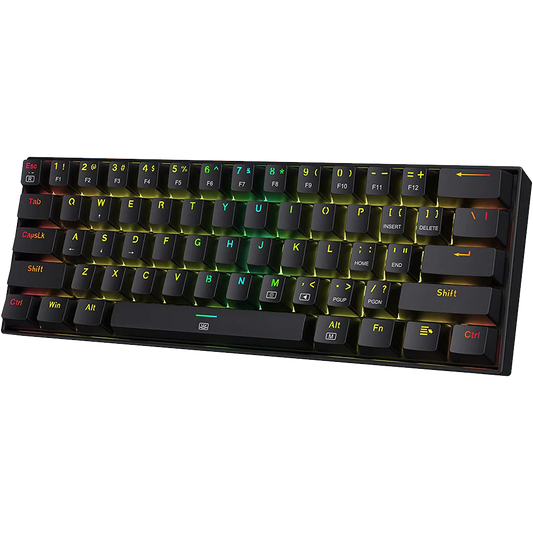

If you spend a lot of time on a computer, you have probably heard people talking about mechanical keyboards. But what exactly is a mechanical keyboard, and why is everyone so obsessed with them?

In this blog, we are going to break it down in simple terms. We will explain how these keyboards work, what makes them different from the standard keyboard. And also the pros and cons of owning one. By the end, you will know if a mechanical keyboard is the right choice for your desk.
What is a Mechanical Keyboard?
To understand a mechanical keyboard, you first need to know what a "normal" keyboard is. Most cheap keyboards use a "membrane" system. Under the keys, there is a thin rubber sheet. When you press a key, the rubber pushes down to complete an electrical circuit. These often feel "mushy" or soft.
A mechanical keyboard is different. Underneath every single key, there is a physical, spring-loaded switch. Because each key has its own moving parts, the keyboard feels much more precise.
What Makes Them Special?
The biggest thing that makes a mechanical keyboard unique is the typing feel. Because you are pressing a real mechanical switch instead of a rubber dome, you get instant feedback. You know exactly when a key has been registered by the computer.

Here are the main components that make these keyboards special:
-
Switches: This is the "engine" of the key. There are hundreds of different types of switches, but they usually fall into three categories:
- Linear: These are smooth and quiet. The key goes straight down and straight up without any "bump" in the middle.
- Tactile: These have a small "bump" you can feel halfway through the press. This tells your fingers that the keypress worked.
- Clicky: These have the bump and a loud "click" sound. They are great for people who love the acoustic feedback of an old typewriter.
There is now a fourth technology sitting alongside these three. Magnetic boards use a sensor to read how far the key has travelled instead of metal contacts, which is how adjustable actuation and rapid trigger become possible. Our guide explains what a Hall effect keyboard is in plain terms.
- Keycaps: These are the plastic covers on top of the switches. You can easily pop them off and change them. This allows people to customize the look of their keyboard with different colors and fonts.
- Acoustics and Sound: These keyboards have a specific sound. Some sound like heavy raindrops, while others sound like crisp clicks. This "thock" or "clack" sound is a big reason why people enjoy typing on them.
- Durability: Because they are built with high-quality plastic and metal springs. They last much longer than standard keyboards. A typical membrane keyboard might last for 5 million clicks, while a mechanical one can last for 50 to 100 million clicks.
Pros and Cons
Switching to a mechanical board is a big change. Before you buy one, it is helpful to look at the good and the bad.
The Pros
1. Better Typing Experience
Most people find that their typing speed and accuracy improve. Because the keys feel more "crisp," you make fewer mistakes. Your fingers don't have to bottom out the key to make it work, which can reduce hand fatigue.
2. Better Typing Experience
You can customize the keyboards to make them truly yours. You can change the keycaps to match your room's aesthetic. You can even choose specific switches that match how hard or soft you like to press your keys.
3. Durability
These keyboards are heavy and sturdy. They don't slide around on your desk, and they can handle years of heavy use without wearing out.
4. Easy to Repair
If one key stops working on a membrane keyboard, you usually have to throw the whole thing away. On a mechanical keyboard, you can often just replace the single broken switch.
The Cons
1. Price
A mechanical board is much more expensive than a standard one. While you can find a good basic keyboard for INR 1500, a decent mechanical one usually starts around INR 3500 and can go up above INR 15,000.
2. Noise
While many people love the sound, your roommates or coworkers might not. Clicky switches can be very loud. If you work in a quiet office, you will need to look for "silent" or linear switches to avoid annoying others.
3. Height and Weight
These keyboards are usually taller and heavier than membrane ones. You might need a wrist rest to stay comfortable, and they aren't the easiest things to carry around in a backpack.
A mechanical keyboard is more than just a tool for typing; for many, it is a way to make their workday more enjoyable. Whether you want the smooth feel of linear switches or the tactile "bump" of a tactile switch, there is a keyboard out there for everyone.
If you spend several hours a day on your computer, the investment in a better typing feel and better acoustic feedback can make a world of difference for your comfort and productivity.