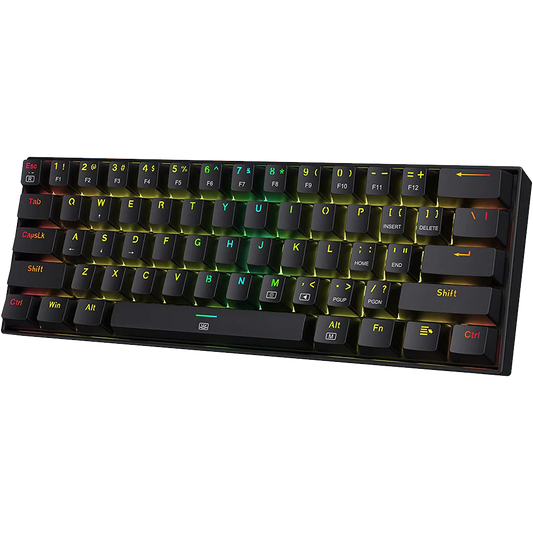

The ATK RS7 Air is a 75% wired Hall effect keyboard that starts at ₹8,299 at Vrkaa. It runs ATK's Gen-3 Blazing Wind ULTRA magnetic switch platform, the same electronics used in the aluminium boards higher up the range. What changes at this price is the case material, not the response. The board polls at 8000 Hz, reports 0.28 ms end-to-end latency, and adjusts Rapid Trigger in 0.001 mm steps.

This review covers the full specification, the difference between the two switch variants, and where the RS7 Air fits for an Indian buyer. Two variants are sold: Lucidblade at ₹8,299 and Iceblade at ₹8,999. The gap is ₹700 and it buys more than a colour choice, which the comparison section below sets out in detail.
ATK RS7 Air: Full Specifications
The table below lists the manufacturer specification for the RS7 Air. Every figure comes from ATK's official product data rather than an estimate. The numbers that matter most for competitive play are the polling rate, the scan rate, and the Rapid Trigger step sensitivity.
| Component | Detail | Notes |
|---|---|---|
| Layout | 75%, 81 keys | Full function row plus four dedicated keys |
| Case material | ABS with aluminium accents | Precision injection-moulded finish |
| Mounting structure | Gasket mount | Adds controlled typing flex |
| Positioning plate | Aluminium | Stiffer and heavier than a PC plate |
| Internal padding | 5 layers: silicone foam, IXPE foam, PET film, EPDM foam, bottom silicone | Targets hollow resonance and case ping |
| Keycaps | Cherry profile PC, frosted top, translucent sides | Lets RGB pass through the sides |
| Switch options | ATK Lucid Blade or ATK Ice Blade | Magnetic, Gen-3 Blazing Wind ULTRA |
| Rapid Trigger range | 0.001 mm to 3.3 mm | Per-key adjustable |
| Step sensitivity | 0.001 mm | Finest step in ATK's range |
| Latency | 0.08 ms | Transmission latency |
| End-to-end latency | 0.28 ms | Keypress to system register |
| Polling rate | 8000 Hz | Wired only |
| Scan rate | 32,000 Hz N-key, 256,000 Hz Extreme | Extreme mode limits simultaneous keys |
| Backlight | South-facing ARGB, 16.8 million colours | Per-key addressable |
| Connectivity | USB-C wired | 1.5 m 8K-rated cable included |
| Functions | RT, SOCD, MT, TGL, adjustable deadzone, key remapping | Configured in ATK HUB |
| Software | ATK HUB | Windows |
| Price at Vrkaa | ₹8,299 (Lucidblade) / ₹8,999 (Iceblade) | Inclusive listing price |
Lucidblade vs Iceblade: Comparing the Two RS7 Air Variants
The RS7 Air is sold as two variants that differ only in the switch and the colours that switch unlocks. Both use the same case, the same plate, the same padding stack and the same controller. Choosing between them is a question of travel distance, light diffusion and colour, not performance tier. Neither variant is faster than the other.
| Specification | ATK Lucid Blade (₹8,299) | ATK Ice Blade (₹8,999) |
|---|---|---|
| Total travel | 3.5 mm plus or minus 0.2 mm | 3.3 mm plus or minus 0.4 mm |
| Actuation force | 35 gf plus or minus 5 gf | 35 gf plus or minus 5 gf |
| Bottom magnetic flux | 480 Gs plus or minus 20 Gs | 480 Gs plus or minus 20 Gs |
| Housing design | Standard opaque housing | Crystal-frosted with prismatic light guide |
| Stated character | Stable actuation, crisp keystroke | Same actuation, stronger RGB diffusion |
| Colours available | White, Black | White, Black, Lake Green, Pink, Orange |
| Price difference | Baseline | ₹700 more |
The measurable difference is travel. Lucid Blade gives 3.5 mm of total travel with a tight 0.2 mm tolerance. Ice Blade gives 3.3 mm with a wider 0.4 mm tolerance. Shorter travel means the key reaches its bottom sooner, which suits players who bottom out on every press and want a shallower keystroke. The 0.2 mm difference is small in absolute terms. It is noticeable back to back and largely invisible after a week of use.
Actuation force is identical at 35 gf, and magnetic flux is identical at 480 Gs. That means Rapid Trigger behaviour, deadzone tuning and SOCD resolution work the same on both. Anyone expecting the more expensive switch to register faster will not find that in the specification.
The Ice Blade housing is the real reason to pay ₹700 more. It uses a crystal-frosted shell with a prismatic light guide, so the south-facing ARGB spreads through the switch body instead of sitting as a point source under the keycap. Combined with the frosted translucent keycaps, the lighting looks considerably more even. Ice Blade is also the only route to Lake Green, Pink and Orange.
Which Variant to Choose
- Choose Lucidblade at ₹8,299 if: you want White or Black, you prefer the slightly longer 3.5 mm travel, and RGB appearance is secondary to price.
- Choose Iceblade at ₹8,999 if: you want Lake Green, Pink or Orange, you prefer shallower 3.3 mm travel, or the lighting quality matters to you.
- Do not choose based on speed: both switches share actuation force, magnetic flux, polling rate and Rapid Trigger precision.
The Gen-3 Blazing Wind ULTRA Platform Explained
A magnetic switch does not close a contact. It carries a magnet in the stem, and a Hall effect sensor on the PCB reads the changing magnetic field as the key moves. The board therefore knows the exact depth of the key at every moment, not just whether it has been pressed. The RS7 Air resolves that depth in 0.001 mm steps across a 0.001 mm to 3.3 mm range.
Two features follow from that. Rapid Trigger resets the key the instant you start lifting it, instead of waiting for it to pass a fixed reset point. For counter-strafing in tactical shooters this removes a real delay between releasing one direction key and registering the opposite one. Adjustable actuation lets you set a hair trigger of a fraction of a millimetre on movement keys and a deeper point on keys you do not want firing by accident.
The other functions are SOCD, MT and TGL. SOCD decides what happens when two opposing direction keys are held together, which matters for movement consistency. MT assigns two actions to one key based on press depth. TGL turns a key into a toggle rather than a hold. All four are set per key in ATK HUB. Note that ATK HUB is Windows software, so macOS users get the hardware defaults without customisation.
Build Quality, Gasket Mount and Acoustics
The RS7 Air uses an injection-moulded ABS case with aluminium accents, which is the main saving compared with the full aluminium boards in ATK's range. The positioning plate is still aluminium, so the switch mounting surface itself is rigid. This combination keeps weight down while preserving a firm keystroke bottom-out.
The mounting is a gasket structure with five internal padding layers: silicone foam, IXPE foam, PET film, EPDM foam and a bottom silicone sheet. Each layer targets a different problem. Silicone and EPDM foam absorb low-frequency vibration. IXPE reduces hollow resonance in the space under the switches. The PET film adds a slight crispness to the return. The practical result is a keyboard that sounds muted and consistent rather than hollow, which is uncommon at ₹8,299 in India.
The keycaps are Cherry profile PC with a frosted top surface and translucent sides. PC is harder and brighter sounding than PBT and it passes light, which is the point here. The frosted top resists finger shine better than gloss. The box also includes spacebar dampening foam and three contrasting keycaps, so some acoustic and visual tuning is possible without buying anything extra.
ATK RS7 Air vs ATK RS63 Air: Choosing a Layout
Vrkaa stocks both Air models and they use identical electronics. The decision is purely about layout and desk space. The RS7 Air is 75% with 81 keys and keeps a full function row. The RS63 Air is a 63% layout with 64 keys and adds an integrated CNC aluminium wrist rest with a front RGB light bar, which the RS7 Air does not have.
| Point of difference | ATK RS7 Air | ATK RS63 Air |
|---|---|---|
| Layout | 75%, 81 keys | 63%, 64 keys |
| Function row | Dedicated F-row | On a layer |
| Wrist rest | Not included | Integrated CNC aluminium with RGB light bar |
| Internal structure | Gasket mount | Leaf flex cantilever |
| Keycap texture | Frosted translucent PC | Carbon fibre texture PC |
| Starting price at Vrkaa | ₹8,299 | ₹7,299 |
If your keyboard also does college work, spreadsheets or office shortcuts, the RS7 Air is the more sensible buy. You keep F1 to F12 without a layer. If your priority is mouse room at low sensitivity and you want the wrist rest included, the RS63 Air saves ₹1,000 and takes noticeably less desk width.
What the ₹8,299 Price Includes in India
Hall effect keyboards at this specification are frequently bought as direct imports, where the unit price looks lower on screen. The gap closes quickly once customs duty, shipping and the exchange rate are added. The more important difference is what happens after the parcel arrives.
Buying the RS7 Air from Vrkaa at ₹8,299 puts the warranty and RMA process inside India. If a switch fails or the controller stops responding, the unit is inspected and replaced domestically. There is no international courier leg, no customs paperwork on the return, and no waiting on an overseas support queue that works in a different time zone. For a wired board that will sit on your desk for several years, that is the part of the purchase that actually gets tested.
Vrkaa also provides ongoing service support for the life of the product, which covers help beyond the warranty term: switch replacement guidance, ATK HUB setup and firmware issues, keycap and stabiliser questions, and diagnosis of faults. Imported units are typically on their own once the warranty period ends. Our detailed breakdown of what good keyboard service looks like in India is worth reading before you compare prices across sellers.
The board ships with a warranty card, user manual, a 1.5 m 8K-rated USB-C cable, a switch and keycap puller, spacebar dampening foam, three extra contrasting keycaps, four backup switches and two brand stickers. The four backup switches matter more than they sound. Magnetic switches are hot-swappable, so a single failed switch is a two-minute fix rather than a service request.
Pros and Cons
Pros
- 8000 Hz polling and 0.28 ms end-to-end latency at ₹8,299, matching the aluminium boards in the range
- 0.001 mm Rapid Trigger step sensitivity across a 0.001 mm to 3.3 mm range
- Aluminium positioning plate and five-layer padding stack, which is unusual in an ABS-cased board at this price
- 75% layout keeps the full function row for mixed work and gaming use
- Hot-swappable magnetic switches with four spares in the box
- Local warranty, domestic RMA and lifetime service support through Vrkaa
Cons
- Wired only, with no 2.4 GHz or Bluetooth option
- ABS case rather than aluminium, so the board is lighter and slides more easily on a bare desk
- ATK HUB is Windows-only, so macOS users cannot configure Rapid Trigger or SOCD
- Lake Green, Pink and Orange are locked to the ₹8,999 Iceblade variant
- No wrist rest included, unlike the RS63 Air
Final Verdict
The RS7 Air is the sensible entry into Hall effect for an Indian buyer who wants one keyboard for everything. It gives up the aluminium case and wireless connectivity, and keeps the parts that determine how the board plays: the switch platform, the polling rate, the Rapid Trigger precision and the aluminium plate. At ₹8,299 that is a clear allocation of budget toward performance rather than finish.
Take the Lucidblade variant unless you want a colour it does not offer or you specifically prefer the shorter 3.3 mm travel. The ₹700 premium on Iceblade buys better lighting and more colour choice, which is worth it to some buyers and irrelevant to others. Either way the competitive performance is identical, and both are covered by the same local warranty and service.