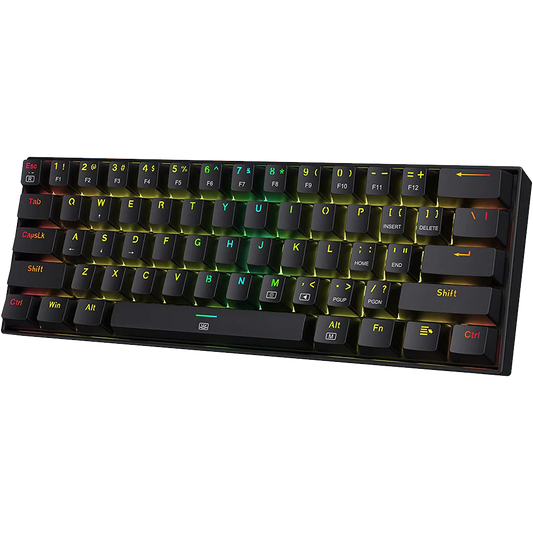

A Hall effect keyboard uses magnetic switches that read how far each key has travelled, instead of detecting a fixed contact point. In India the category has moved from niche esports gear to mainstream in about two years, with entry models such as the ATK RS63 Air and the ATK RS7 Air now starting at ₹7,299. The terminology has not kept up. Rapid Trigger, actuation point, scan rate and SOCD get used interchangeably in listings and reviews, often incorrectly.
This guide explains what each one actually does, and where the technology helps you.

How a Magnetic Switch Differs From a Mechanical Switch
A mechanical switch works like a physical circuit. Metal leaves inside the switch housing meet at a fixed depth, the circuit closes, and the keyboard registers a keypress. That depth never changes. On a typical linear switch it sits somewhere between 1.4mm and 2.0mm of travel. Once the contact is made, the key stays registered until you lift far enough to break it again.
A Hall effect switch has no metal contact at all. It contains a small magnet in the stem and a sensor in the PCB. As the stem moves down, the magnetic field strength at the sensor changes. The controller reads that field and converts it into a travel distance. Instead of a yes-or-no signal, the keyboard knows the exact position of the key at every moment.
That single difference is what everything else is built on. The switch also has no physical contact to wear out, which is why magnetic switches carry much higher rated lifespans than contact switches.
Actuation Point: Setting Your Own Trigger Depth
Because the board reads position continuously, you choose the depth at which a key fires. Most Hall effect boards allow a range of roughly 0.1mm to 3.5mm, adjustable per key.
The practical use is different per key, not global. Movement keys benefit from a shallow setting near 0.3mm, because the key fires almost as soon as you touch it. Keys where an accidental press is costly, such as a grenade bind or a push-to-talk key, work better at 2.0mm or deeper. On a mechanical board every key shares one fixed depth and you have no say in it.
Typing is the other side of this. A very shallow actuation point across the whole board produces frequent accidental inputs during normal typing. Most people who use these boards for work as well as gaming keep the alphanumeric cluster at a normal depth and only shorten the movement keys.
Rapid Trigger: The Feature That Actually Matters
Rapid Trigger is the reason competitive players buy these keyboards. On a normal keyboard, a key stays registered until it rises above a fixed reset point. If you press and release quickly without fully lifting, the second press may not register at all.
Rapid Trigger removes the fixed reset. The key releases the moment it starts moving upward, and re-registers the moment it starts moving down again, wherever in the travel that happens. The sensitivity of that reversal is set as a distance value.
The ATK RS7 Air and ATK RS63 Air both expose Rapid Trigger at 0.001mm step precision. That number is the granularity of the adjustment, not a claim that human fingers move in one-micron increments. It matters because it lets you tune the reversal threshold finely enough to stop double-inputs from finger tremor while keeping the response fast.
In practice the benefit shows up in counter-strafing in tactical shooters, and in any situation involving rapid direction changes. Reddit users on r/MechanicalKeyboards and r/IndianGaming consistently describe counter-strafing as the single change they notice immediately after switching. For slower genres the difference is much harder to feel.
Scan Rate and Polling Rate: Two Different Numbers
These two specs get conflated constantly in product listings, so it is worth separating them.
Scan rate is how often the keyboard checks the position of each key internally. The RS63 Air and RS7 Air both run a 32,000 Hz per-key scan rate. Higher scan rate means the board has a more current picture of where every key sits, which is what makes fine Rapid Trigger settings usable.
Polling rate is how often the keyboard reports to your PC over USB. Both ATK Air models run 8000 Hz polling, against the 1000 Hz that most wireless mechanical keyboards use. The combined end-to-end latency on these boards is quoted as low as 0.28ms.
| Specification | What it measures | What to look for |
|---|---|---|
| Scan rate | Internal per-key position reads | Above 8,000 Hz for usable Rapid Trigger |
| Polling rate | Reports sent to the PC | 1000 Hz is sufficient. 8000 Hz is a competitive extra |
| Rapid Trigger step | Adjustment granularity | 0.01mm or finer |
| Actuation range | Adjustable trigger depth | Roughly 0.1mm to 3.5mm |
An 8000 Hz polling rate does increase CPU overhead. On mid-range Indian gaming builds running an i5 or Ryzen 5 class processor this is rarely a problem, but it is not free performance either.
SOCD and Snap Tap: Where the Rules Changed
SOCD stands for Simultaneous Opposing Cardinal Directions. It describes what a keyboard does when you hold two opposite movement keys at the same time, most commonly A and D.
Standard behaviour is that both inputs cancel and the character stops. SOCD handling changes this so the most recently pressed key wins, letting the character switch direction instantly with no stopping frame. Vendors market this under various names including Snap Tap and Last Key Priority.
This is where you need to be careful. Several competitive titles have banned SOCD resolution features outright, and anti-cheat systems in some games detect and flag them. Valorant and Counter-Strike 2 have both taken positions restricting this class of feature. Rapid Trigger itself remains permitted in the major titles.
The practical advice is straightforward. Buy a Hall effect keyboard for Rapid Trigger and adjustable actuation, which are broadly allowed. Treat SOCD features as optional and check the current rules for the specific game you play competitively before enabling them.
Where Hall Effect Is Not the Right Choice
These boards are competitive tools, not a general upgrade over good mechanical keyboards. Several trade-offs are worth stating plainly.
- Switch compatibility: magnetic switches are not interchangeable with MX-style mechanical switches. The hot-swap ecosystem you may already own does not carry over.
- Typing feel: magnetic switches are almost all linear. If you prefer tactile or clicky switches, the options are very limited.
- Sound: a well-built gasket-mounted mechanical board such as the ATK V75X generally sounds better than an equivalent plastic Hall effect board, because acoustic tuning has been the design priority in that category for longer.
- Price floor: entry Hall effect boards in India start around ₹7,299. Good 75% mechanical boards start well below that.
If you play tactical shooters at a competitive level, the response advantage is real and measurable. If you type for most of the day and game casually in the evening, a gasket-mounted mechanical board is the better purchase at the same price.
Hall Effect Keyboards Available at Vrkaa
Vrkaa currently stocks two models from the ATK Air range, both running the Gen-3 Blazing Wind ULTRA magnetic platform.
The ATK RS63 Air uses a 63-key compact layout with dedicated arrow keys, and is the only model in the range with an integrated CNC aluminium wrist rest. It starts at ₹7,299 with Lucid Blade switches.
The ATK RS7 Air uses a 75% layout with 81 keys, keeping the full function row. It starts at ₹8,299 with Lucidblade switches. For anyone splitting time between office work and gaming, the retained F-row usually makes this the more practical of the two.
Both are covered in more detail in the RS63 Air review and the RS7 Air review. If you are still deciding between magnetic and mechanical, the membrane, mechanical and magnetic comparison covers the categories side by side.
Why Indian Buyers Choose Vrkaa
Buying peripherals in India has a problem that specifications do not solve. Many of the best value products come from brands with no Indian presence. When something fails, the warranty claim becomes an overseas RMA that takes months and costs more in shipping than the product is worth. That risk is the reason a lot of Indian buyers stay on older, more expensive gear than they need to.
Vrkaa Gears Private Limited is a registered Indian company based in Amravati, Maharashtra, and ships only within India. Support and returns are handled domestically. When something goes wrong you email admindesk@vrkaa.com and deal with a team in the same country and the same time zone, rather than a ticket queue abroad.
The terms are published rather than implied:
- Dispatch: orders are typically processed within one business day of payment confirmation.
- Delivery: standard shipping runs 1 to 7 business days across India, with a tracking number emailed once the order ships.
- Returns: a 14-day window from the date you receive the item, in original condition and packaging.
- Dead on arrival: a 48-hour reporting window with no return shipping charge, and approved refunds processed to the original payment method within 10 business days.
- Pre-purchase advice: you can ask before ordering. Hand size, switch choice and layout questions get a straight answer rather than a push toward the most expensive option.
One practical note that saves most disputes: record or photograph the package condition at delivery, with the sealed label visible. Vrkaa asks for this on damage and DOA claims, and having it is the difference between a claim that clears quickly and one that stalls.
The team is also active where Indian gamers actually are, across Instagram, YouTube, Discord, Facebook and X, which matters when you want to ask a question without opening a support ticket. The site carries published customer reviews, and a VRKAA Coins loyalty programme that returns value on repeat orders. Community events have included the VRKAA TAP Valorant tournament.
Frequently Asked Questions
Is a Hall effect keyboard worth it for casual gaming
For casual gaming the benefit is small. Rapid Trigger helps most in tactical shooters that involve constant direction changes. If you play story games, racing or strategy titles, a good mechanical keyboard delivers a better typing experience at a lower price.
Can you replace the switches on a Hall effect keyboard
You can swap magnetic switches on hot-swap Hall effect boards, but only with other magnetic switches. Standard MX-compatible mechanical switches will not work, because the board reads a magnetic field rather than an electrical contact.
Does Rapid Trigger get you banned in Valorant or CS2
Rapid Trigger is permitted in the major competitive titles. SOCD resolution features, sometimes marketed as Snap Tap or Last Key Priority, have been restricted in several games. Check the current rules for your title before enabling SOCD handling.
What is the difference between scan rate and polling rate
Scan rate is how often the keyboard reads its own key positions internally. Polling rate is how often it reports those readings to your PC. The ATK Air models run a 32,000 Hz per-key scan rate and 8000 Hz polling.
How much does a Hall effect keyboard cost in India
Entry models start around ₹7,299. The ATK RS63 Air starts at ₹7,299 and the ATK RS7 Air at ₹8,299 at Vrkaa. Aluminium-cased models sit meaningfully higher.