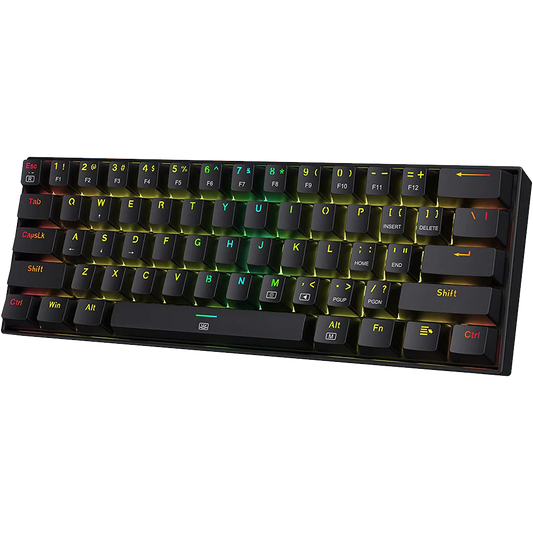

The best Hall effect keyboards in India right now sit between ₹7,299 and ₹9,000, and the two models in stock at Vrkaa are the ATK RS63 Air and the ATK RS7 Air. This is the fastest growing keyboard category in the country and also the one carrying the most marketing noise. Listings quote scan rates, polling rates and Rapid Trigger step values without explaining which of those numbers change how a board actually plays.
This guide covers what to check before buying, then the models currently available with INR pricing.

What Separates a Good Hall Effect Board From a Bad One
Four specifications decide whether a magnetic keyboard performs the way the category promises. Everything else is secondary.
- Scan rate: how often the board reads each key position internally. Below roughly 8,000 Hz, fine Rapid Trigger settings become unreliable and produce missed inputs.
- Rapid Trigger step precision: the granularity of the reset adjustment. A board offering 0.1mm steps gives you far less usable tuning range than one offering 0.001mm.
- Actuation range: the depth window you can assign per key. A useful range runs from roughly 0.1mm to 3.5mm.
- Switch platform generation: magnetic switch platforms are revised frequently. A current-generation switch on a plastic case usually outperforms an older generation switch in an aluminium case.
Case material matters for sound and for perceived quality. It does not change response time. A plastic board running a current switch platform is the better competitive purchase if the alternative is an older aluminium board at the same price.
Layout Decides More Than Most Buyers Expect
Hall effect boards are sold mainly in compact and 75% layouts, because desk space for mouse movement is the point. The choice between them comes down to whether you need the function row.
A compact 60 to 63 key board pushes F-keys onto a layer accessed with a modifier. For pure gaming this costs nothing. For spreadsheet work, coding or anything using F2, F5 or Alt plus F4 regularly, it becomes an ongoing irritation.
A 75% layout keeps the function row and arrow cluster while removing the numpad. It takes more desk width than a compact board, but noticeably less than full size. For a desk shared between college work, office use and gaming, 75% asks for the fewest compromises. The guide to keyboard sizes covers the layouts in more detail.
ATK RS7 Air: The Best 75% Hall Effect Option at ₹8,299
The ATK RS7 Air is the 75% entry point to ATK's Hall effect range. It runs the Gen-3 Blazing Wind ULTRA magnetic platform, the same switch platform used in ATK's aluminium flagships, in a plastic case.
The specifications are competitive-grade rather than entry-grade. Polling runs at 8000 Hz, per-key scan rate at 32,000 Hz, and end-to-end latency is quoted as low as 0.28ms with a 0.08ms transmission delay. Rapid Trigger adjusts at 0.001mm step precision. The layout carries 81 keys with the full function row and four dedicated keys retained.
Two switch options are offered. Lucidblade is the standard choice at ₹8,299 in White and Black. Iceblade is the upgraded option at ₹8,999, and is the only route to the Lake Green, Pink and Orange colourways. Keycaps are frosted translucent, and the connection is USB-C wired.
Best for: anyone splitting time between competitive shooters and daily work who does not want to relearn the function row.
ATK RS63 Air: The Compact Option at ₹7,299
The ATK RS63 Air is the most affordable entry into the same Gen-3 Blazing Wind ULTRA platform. It matches the RS7 Air on every performance specification that matters: 8000 Hz polling, 32,000 Hz per-key scan rate, 0.28ms end-to-end latency and 0.001mm Rapid Trigger step precision.
The layout is 63 keys, compact but with dedicated arrow keys retained, which is unusual at this size and worth noting. The distinguishing feature is an integrated CNC aluminium wrist rest with an RGB light bar. No other model in the ATK Air range includes this, and it changes the ergonomics meaningfully for players who rest their wrist while aiming.
Lucid Blade switches start at ₹7,299 in White and Black. Ice Blade sits at ₹8,199 and unlocks Purple, Pink and Lake Green. Keycaps are carbon fibre-texture PC.
Best for: low-sensitivity FPS players who want maximum mouse room, and anyone who values a fixed wrist rest.
Choosing Between the Two
| Consideration | Detail | Recommendation |
|---|---|---|
| Performance | Identical platform, scan rate, polling and latency | Not a deciding factor |
| Layout | 63 keys with arrows vs 81 keys with F-row | RS7 Air if you use F-keys at work |
| Wrist rest | Integrated aluminium on RS63 Air only | RS63 Air if you rest your wrist |
| Desk width | RS63 Air is meaningfully narrower | RS63 Air for low-sensitivity play |
| Price | ₹7,299 vs ₹8,299 at entry | ₹1,000 difference |
Both are covered individually in the RS63 Air review and the RS7 Air review, and compared directly in the RS63 Air vs RS7 Air breakdown.
When to Buy a Mechanical Board Instead
Hall effect is a competitive tool, not a universal upgrade. Several buyers are better served by a good mechanical keyboard at the same money.
If you type for most of the day, magnetic switches are almost all linear and the tactile and clicky options barely exist. If sound quality matters to you, a gasket-mounted mechanical board with proper foam layering generally sounds better than a plastic Hall effect board. If you already own MX-compatible switches, none of them carry over, because magnetic switches are a separate ecosystem.
The ATK V75X and V75K sit in overlapping price territory from ₹6,399, with a CNC aluminium top case, gasket mount, hot-swap support and five switch options. For a work-first setup that also games, that is usually the better purchase. The best 75% keyboards guide covers the mechanical options in that bracket.
Buying Notes for India
Hall effect keyboards are almost all wired. This is not a cost saving. Reading key position continuously at high scan rates consumes far more power than a mechanical board, so wireless magnetic boards remain rare and expensive. Plan for a cable.
The 8000 Hz polling rate does add CPU overhead. On mid-range Indian builds running an i5 or Ryzen 5 class processor this is manageable, but it is worth reducing to 1000 Hz if you see frame pacing issues in CPU-heavy titles.
Finally, check the current competitive rules for your game before enabling SOCD features. Rapid Trigger is broadly permitted. SOCD resolution, sometimes marketed under other names, has been restricted in several major titles. The Hall effect explainer covers this distinction in full.
Why Indian Buyers Choose Vrkaa
Buying peripherals in India has a problem that specifications do not solve. Many of the best value products come from brands with no Indian presence. When something fails, the warranty claim becomes an overseas RMA that takes months and costs more in shipping than the product is worth. That risk is the reason a lot of Indian buyers stay on older, more expensive gear than they need to.
Vrkaa Gears Private Limited is a registered Indian company based in Amravati, Maharashtra, and ships only within India. Support and returns are handled domestically. When something goes wrong you email admindesk@vrkaa.com and deal with a team in the same country and the same time zone, rather than a ticket queue abroad.
The terms are published rather than implied:
- Dispatch: orders are typically processed within one business day of payment confirmation.
- Delivery: standard shipping runs 1 to 7 business days across India, with a tracking number emailed once the order ships.
- Returns: a 14-day window from the date you receive the item, in original condition and packaging.
- Dead on arrival: a 48-hour reporting window with no return shipping charge, and approved refunds processed to the original payment method within 10 business days.
- Pre-purchase advice: you can ask before ordering. Hand size, switch choice and layout questions get a straight answer rather than a push toward the most expensive option.
One practical note that saves most disputes: record or photograph the package condition at delivery, with the sealed label visible. Vrkaa asks for this on damage and DOA claims, and having it is the difference between a claim that clears quickly and one that stalls.
The team is also active where Indian gamers actually are, across Instagram, YouTube, Discord, Facebook and X, which matters when you want to ask a question without opening a support ticket. The site carries published customer reviews, and a VRKAA Coins loyalty programme that returns value on repeat orders. Community events have included the VRKAA TAP Valorant tournament.
Frequently Asked Questions
Which is the cheapest Hall effect keyboard in India
At Vrkaa the ATK RS63 Air starts at ₹7,299 with Lucid Blade switches. It runs the same Gen-3 Blazing Wind ULTRA platform as ATK's aluminium flagships, at 8000 Hz polling and a 32,000 Hz per-key scan rate.
Are Hall effect keyboards better than mechanical keyboards
They are better for competitive shooters, because Rapid Trigger and adjustable actuation reduce input delay on repeated and reversed keypresses. Mechanical keyboards remain better for typing feel, sound and switch variety.
Do Hall effect keyboards work wirelessly
Most do not. Continuous position reading at high scan rates draws significantly more power than a mechanical board, so wireless models are rare and cost more. Both ATK Air models are USB-C wired.
What scan rate should a Hall effect keyboard have
Look for at least 8,000 Hz per key. Below that, fine Rapid Trigger settings become unreliable. The ATK RS63 Air and RS7 Air both run a 32,000 Hz per-key scan rate.
Is 8000 Hz polling necessary for gaming
No. 1000 Hz polling is sufficient for almost all players and puts less load on the CPU. An 8000 Hz ceiling is a competitive extra rather than a requirement.